The Self-Review Kit
Write a self-review that puts your results first, not a list of tasks
Your review form has a few short boxes and a strict word or character limit, but the year of work behind it is scattered across emails, reports and project notes. Without a method, the draft turns into a list of tasks and your best results get buried.
Get the kit · $29Instant access · one-time payment
- 56page PDF eBook
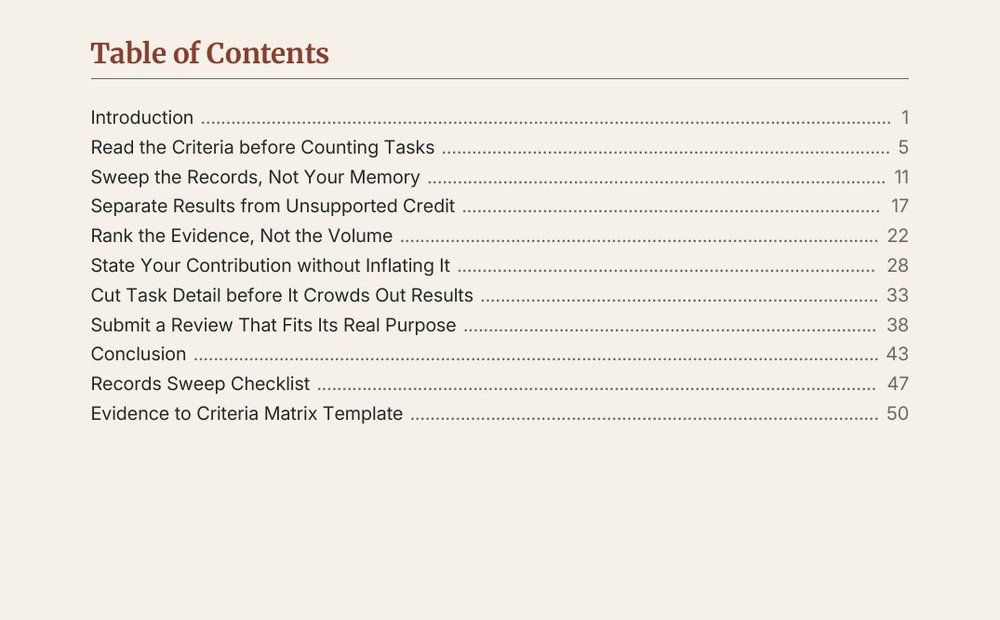
- 7chapters in order of use
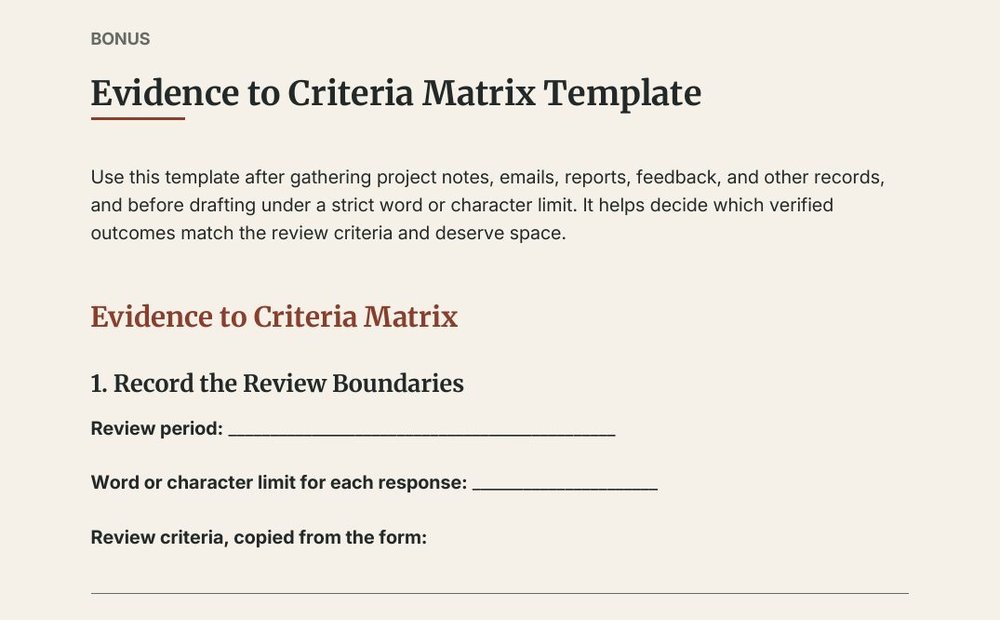
- 2fill-in templates
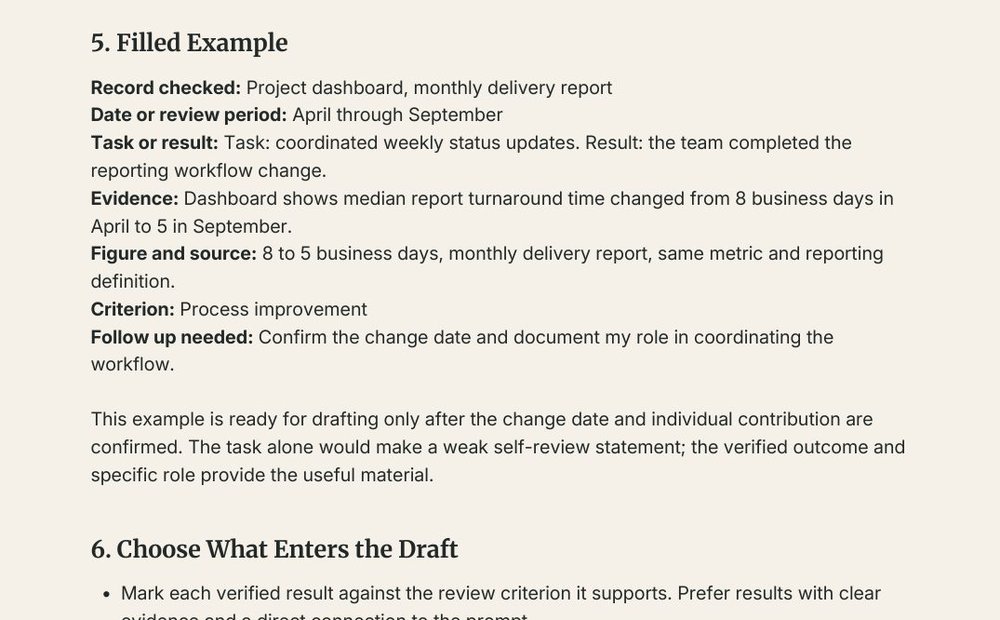
- 1filled example
To write a strong self-review under a strict limit, read the form's criteria first, gather evidence from your records instead of memory, separate real results from completed tasks, rank the evidence against each criterion, state your contribution accurately, and cut task detail until the results are easy to find. The Self-Review Kit walks you through each step.
What's inside
- Read the criteria first. Turn each criterion and word or character limit into a question your evidence has to answer
- Sweep your records, not your memory. Find results in project notes, emails, feedback, reports and spreadsheets
- Separate results from unsupported credit. Tell completed tasks from real outcomes, trace each number to its source and credit shared work accurately
- Rank the evidence. Compare outcomes by relevance and support so the strongest ones get the limited space
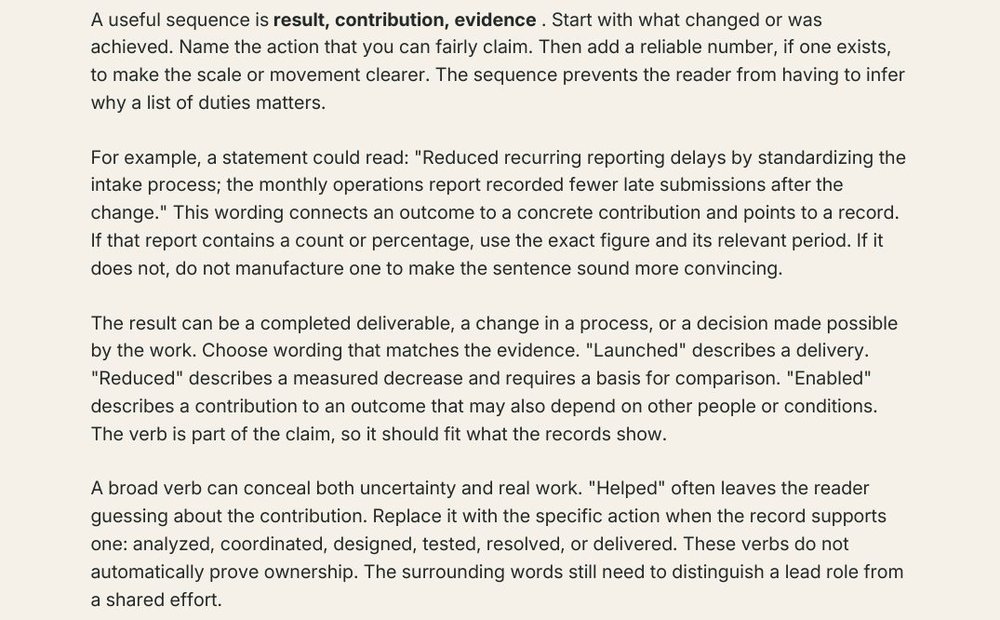
- State your contribution. A result, contribution, evidence sequence with example sentences
- Cut task detail. An editing order for trimming to the limit without losing the result or your role
- Final audit. A pass or revise check for criterion, evidence, attribution and length
- Records Sweep Checklist (bonus). A one-sitting checklist with a filled example
- Evidence to Criteria Matrix (bonus). A fill-in template to compare outcomes against criteria and rank them
Look inside
How to use it
- Write down the limit and the criterion for each response (20 minutes)
- Sweep your records with the checklist and log what you find
- Check your numbers and what part of each result was yours
- Fill in the matrix and pick the strongest results for each response
- Draft each one result first, cut task detail, then audit it against the limit
Who it's for
- Employees whose review form has short responses or strict word or character limits
- People who do good work but whose drafts turn into a list of tasks
- Anyone who wants to back a self-review with evidence they can point to
What it isn't
- It isn't HR, legal or career advice, and it can't guarantee a rating, a raise or a promotion
- It's a method with templates, not a collection of complete sample self-reviews or a phrase bank
- It won't help much if you have no records of your work yet; the final chapters show how to start keeping them
Questions
Is it only for reviews with strict limits?
It's built for short responses and word or character limits, but the method of starting with criteria, evidence and results works for longer forms too.
Does it include sample self-reviews?
Not full ones. It has example sentences inside the chapters and a filled example in the checklist, but it's a method with templates rather than a collection of complete reviews.
I already know what I worked on. Do I really need another writing guide?
This isn't a writing guide. It solves a different problem: turning your work activity into supported results that answer your review criteria. The Records Sweep Checklist and the Evidence to Criteria Matrix help you organize the records you already have and decide what earns space in your review.
I don't have time to go through a whole year of records.
You won't need to. The method gives the search a clear structure: you start from your review criteria, list the likely sources, note candidate results, and stop once the useful records and open questions are captured. It is designed to avoid an open-ended search through every file.
What if I don't have reliable numbers for my work?
You don't need a number in every statement. The kit shows you how to trace each figure to a source and, when no dependable figure exists, how to state a clear result in words instead of guessing.
I don't want to sound boastful or take credit for my team's work.
The kit separates the team's outcome from your documented role. Its statement sequence helps you write direct, accurate sentences without claiming sole ownership and without retreating into vague modesty.
Will this make my manager recognize my work or improve my review?
It helps make your supported results easier to find and understand, but it can't control how a manager reads a review or what your organization decides. The process is based on your review criteria and your workplace records. We have not attached scientific research for the method.
Can I get a refund?
Because it's an instant digital download, all sales are final. If a file doesn't open or download correctly, write to hello@thefixguides.com and we'll fix it or send you a working copy.
How do I get it?
You pay securely on this page and get instant access. Whop emails you a link to download the PDF, and you can download it again anytime.
Free answers on this topic
Last updated 2026-10-22. Written by Jorge Orozco. How we write our guides.
Related guides
The Raise Kit
Your job has grown, your paycheck hasn't, and every time you try to bring it up the conversation turns into praise instead of a decision.
47-page PDF toolkit + Excel raise calculator
Get the kit · $29The Offer Negotiation Kit
You got the offer, it's lower than you hoped, and you're afraid that asking for more will make them change their mind.
70-page PDF eBook with 2 worksheets
Get the kit · $29